
The Launchpad: Foundations of Systematic Review & Meta-Analysis Protocol Design – Academic / Research Group
€1,800.00
Course 1 of 12 · Foundation Phase · 10 Seats · 5–6 Hours Video · 9 Hours Total Learning
Ten seats of the full Launchpad course for a research group, lab, or department. Each member builds a PRISMA-P compliant systematic review protocol on their own real research project and registers it publicly by the end of the course. Each member earns the SynClarity Seal upon successful capstone completion.
68 Video Lessons
5 Smart Interactive Modules
Audio Recaps & Text Summaries
Workbook Templates
Lifetime Access
SynClarity Seal per Member
Invoice/PO Available
Applicable across medicine, education, psychology, HEOR, policy, law, agriculture, social science, and any discipline where evidence informs decisions.
✓ €180 per seat vs €299 individual · ✓ Invoice payable for institutions · ✓ Founding Cohort · Limited Groups
Description
Course 1 of 12 · Foundation Phase · 10 Seats · One Enrollment
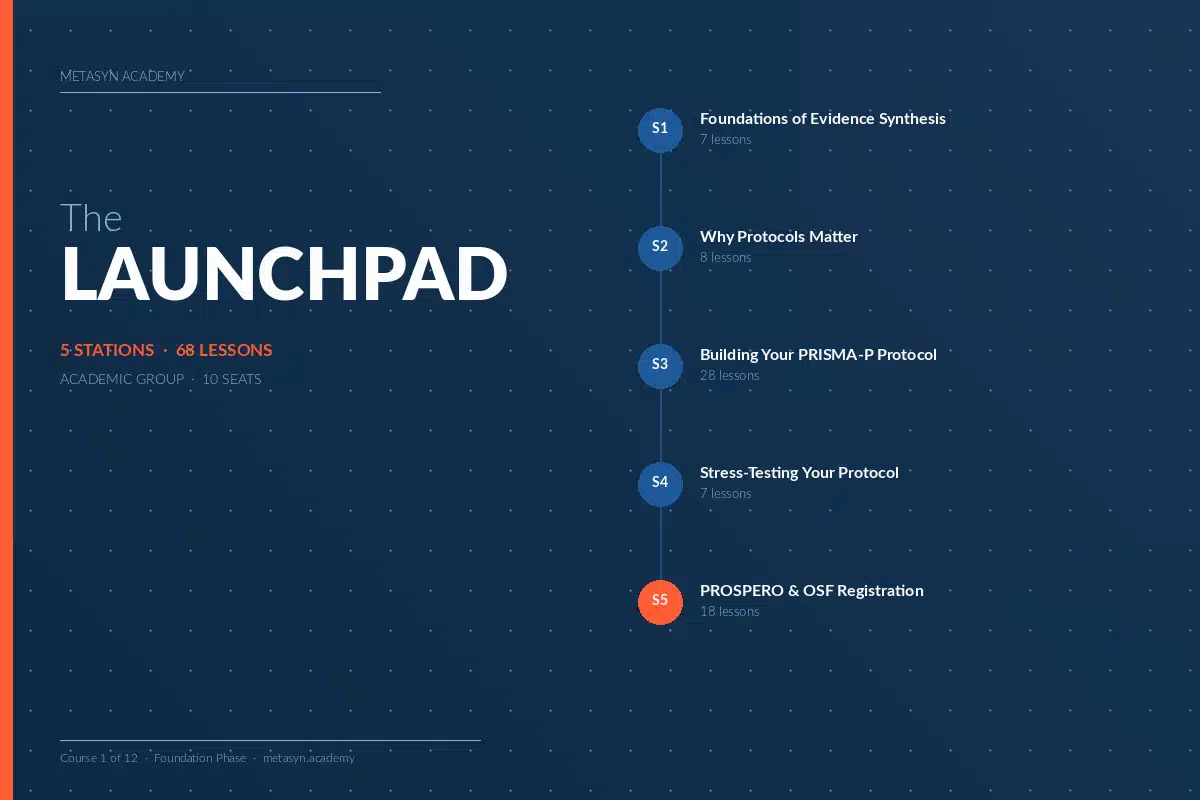
The Launchpad is a 5-station, 68-lesson expedition through the complete architecture of a systematic review protocol. The Academic Group License enrolls your entire team at once: ten researchers, one enrollment, one invoice. Every member builds a PRISMA-P compliant protocol on their own real research project and registers it publicly by the end of the course.
Academic Group License: What This Tier Provides
Full course access for 10 researchers. The same 68 lessons, 5 stations, and complete asset library. Every member progresses at their own pace. One institution pays once.
Group Rate: €180 per Seat
€1,800 for 10 seats. At the individual rate of €299 per researcher, the same 10 enrollments cost €2,990. This license saves your institution €1,190: 40% off individual pricing.
How Seats Work
Each seat is a full individual enrollment. Members activate their own account and progress independently. Seats are assigned to specific researchers by the purchasing contact after enrollment.
Invoice and Purchase Order Accepted
Institutional procurement requires an invoice rather than a card payment. Email [email protected] with your institution name and PO number. Seats activate upon payment confirmation.
Best suited for: PhD supervisors enrolling a thesis cohort, department heads standardizing review methodology across a research unit, and clinical or policy team leads preparing a group for a multi-review program.
Five Outcomes Each Member Will Hold by Station 1.5
✓
A PRISMA-P compliant protocol document (typically 3,000–5,000 words) covering all 17 checklist items, citable, auditable, and ready for peer review
✓
A live public pre-registration on PROSPERO, the Open Science Framework, or both, with each researcher’s name on the scientific record
✓
A structured, answerable research question built using the right framework for the discipline: PICO, PECO, SPIDER, ECLIPSE, PCC, or PIRT
✓
A reproducible research workspace, including structured reference management, file-naming conventions, and citation libraries ready for Course 2
✓
The SynClarity Seal of Methodological Rigor, earned individually by each member upon successful capstone submission and criteria confirmation
One Method. Every Field That Runs on Evidence.
Systematic review protocol design is not a specialty of any single discipline. A research group spanning multiple disciplines can enroll together. Each member applies the method to their own research question, regardless of field.
Psychology
Education
HEOR & Market Access
Policy
Law
Agriculture
Social Science
Applied Linguistics
Environmental Science
No statistics background required. No coding. No prior research experience.
The Five Stations
Each station is a self-contained chapter. Each member arrives, works, produces something tangible, and advances. Their real research project runs through every one.
Foundations of Evidence Synthesis
The lineage of the method: from Florence Nightingale’s mortality charts to the Cochrane Collaboration to modern evidence hierarchies. 7 lessons. Each member will understand why this method exists, and what is at stake when it is done poorly, before beginning to use it.
Why Protocols Matter
The scientific and ethical case for committing the methodology to writing before the review begins. Transparency, reproducibility, bias prevention, and accountability: the four pillars. 8 lessons. By the end, the protocol is no longer a procedural formality. It is a methodological contract with the scientific community.
Building Your PRISMA-P Protocol
All 17 PRISMA-P checklist items, built from scratch. Every major question framework: PICO, PECO, SPIDER, ECLIPSE, PCC, and PIRT. Each member selects the right one for their discipline and research type, then builds every section of their actual protocol around it. 28 lessons. The longest station. The most consequential one.
Stress-Testing Your Protocol
Before a protocol goes public, it is examined under pressure. The Pre-Mortem Workshop, the Integrity Audit, and the External Stress Test: three structured exercises designed to find every structural weakness before the scientific record carries the researcher’s name. 7 lessons.
PROSPERO and OSF Registration: Field by Field
Station 5 is field work. Every field of the PROSPERO registration form is demonstrated, step by step. Each member copies their completed protocol directly into the registry, sets up an Open Science Framework preregistration, and builds the file architecture for the full review. 18 lessons. Each member leaves this station with a live, publicly accessible scientific record.
What Each Seat Includes
68 Video Lessons
5–6 hours of video across 5 stations. Each lesson is self-contained. Each member progresses at their own pace with no group scheduling required.
5 Smart Interactive Modules
One per station. Custom-built HTML-based tools each member actively uses, not passive slides. No other evidence synthesis course offers these.
5 Audio Recaps
One per station. Designed for on-the-go reinforcement: commutes, between writing sessions, or any time away from the screen.
5 Station Text Summaries
Written digests of each station’s core methodology. Reference material that stays useful long after the course is complete.
PRISMA-P Protocol Workbook
A ready-to-fill Word document structured around all 17 PRISMA-P items. Each member finishes the course with a completed document, not a blank template.
Framework Workbook
Six question frameworks (PICO, PECO, SPIDER, ECLIPSE, PCC, PIRT) with 18 fully worked real-world examples. Includes a diagnostic selector to identify the right framework for each review type.
Review Type Decision Tool
A decision flowchart comparing systematic, scoping, rapid, umbrella, and narrative reviews. Minimum study requirements, registration obligations, and realistic timelines for each.
Quizzes + Final Assessment
Verification checkpoints throughout the course. The final assessment confirms each member’s readiness for capstone submission.
Lifetime Access
Each seat provides permanent access. Members return to any station as their research evolves or as they guide future students through the same process. No expiry.
MetaSyn AI Skill Coming Soon
The first AI Skill purpose-built for evidence synthesis. GVD protocol embedded in every interaction. Deployable on Claude, ChatGPT, and Gemini. Launching within 30 days of academy launch, included at no additional cost.
Certificate of Completion
Issued to each member upon successful completion with a unique verification ID. Permanently verifiable at metasyn.academy/verify. Citable and employer-confirmable.
The Capstone Project
Course 1 culminates in a real-world deliverable built on each member’s own actual research project. Each member independently submits their PRISMA-P protocol together with confirmation of their PROSPERO or OSF registration. Assessments are individual.
Assessment Criteria (Same for Every Member)
- A clear, answerable research question using PICO, PECO, SPIDER, ECLIPSE, PCC, or PIRT
- A comprehensive search strategy across a minimum of three databases
- Explicit eligibility criteria and a reproducible study selection process
- Defined data extraction procedures and risk-of-bias assessment approach
- An appropriate synthesis plan, narrative or meta-analytic, matched to the research question
- Complete PRISMA-P checklist and confirmed PROSPERO or OSF registration
Each member receives automated criteria feedback. Protocols meeting all criteria earn the SynClarity Seal of Methodological Rigor.
The SynClarity Seal of Methodological Rigor
From DisClarity to SynClarity. The credential that marks where the journey ends.
Every researcher arrives at the Academy in a state of DisClarity: a sound question buried under methodological uncertainty, scattered references, and the weight of not knowing where to begin. The SynClarity Seal marks the moment that ends. It certifies that what each member has built is not just a completed exercise. It is a defensible, registered, replication-ready protocol that has passed independent methodological review.
The Seal is endorsed by a published meta-analyst whose second-order meta-analysis appears in Nature Human Behaviour (2026). No other evidence synthesis academy currently offers an equivalent credential. It is a digital badge each member can display on their CV, LinkedIn profile, and published work.
Earned individually by each group member upon successful capstone submission and criteria confirmation.
Who This License Is For
The Academic Group License is designed for the person who pays once and equips a team. The course content is identical to the Individual tier. The value is in enrolling a cohort together at a significantly reduced per-seat cost.
PhD Supervisors
PIs enrolling a full thesis cohort to establish a shared methodological foundation across the research group.
Research Department Heads
Department leads standardizing systematic review methodology across a faculty, school, or research unit.
Clinical Research Units
Hospital or clinical research team leads preparing a unit for a multi-review program, grant application, or guidelines development process.
Policy Research Teams
Government or agency heads enrolling policy research staff ahead of a systematic evidence cycle or regulatory submission program.
Institutional Procurement
Institutions requiring an invoice or purchase order rather than a card payment can request one by emailing [email protected] with the institution name, billing contact, and PO number. Seats are activated upon payment confirmation. A formal invoice in PDF format is issued for every group enrollment.
For groups larger than 10 seats or multi-cohort institutional agreements, contact the same address to discuss custom arrangements.
Prerequisites
None. No statistics background. No prior research experience. No specific software required. Members need only a research question and the commitment to work through five stations.
8,000+
Researchers trained through previous editions of Dr. Robat’s systematic review programs on Faradars and Maktabkhooneh, now expanded for a global English-speaking audience through MetaSyn Academy.
30-Day
Money-Back Guarantee
If the group is not satisfied for any reason within 30 days of enrollment, a full refund is issued. No questions asked.
About the Instructor
Dr. Esmaeel Saeedy Robat is a published meta-analyst and the founder of MetaSyn Academy. His second-order meta-analysis on evidence synthesis methodology appears in Nature Human Behaviour (2026) and his work spans Review of Educational Research and Educational Psychology Review. He has trained more than 8,000 researchers through previous systematic review programs and designed the Meta-Journey curriculum to give every researcher, regardless of field, institution, or background, access to the same methodological standards used in world-class systematic reviews. ORCID: 0000-0001-9899-8523 · Scopus: 58854019900.
Reviews
There are no reviews yet.