
Dr.
Esmaeel
Saeedy Robat
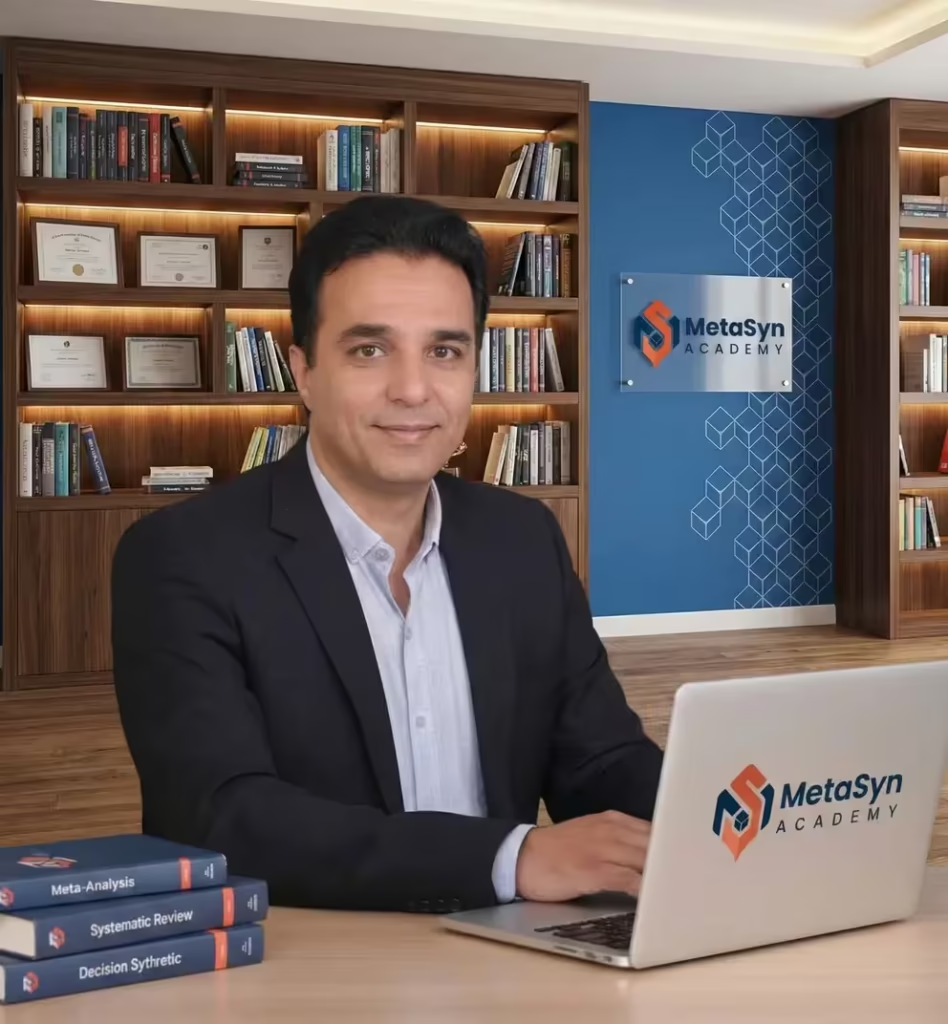
A working methodologist’s academy, built by someone who publishes the work he teaches.
First and corresponding author of published research in Nature Human Behaviour (2026), with a highly cited ISI paper on Robot-Assisted Language Learning in Review of Educational Research. Corresponding author of two multilevel meta-analyses in Educational Psychology Review, including co-authored work with Prof. Richard M. Ryan, co-founder of Self-Determination Theory. Fifteen years training researchers in evidence-synthesis methodology.
Nature Human Behaviour · Impact Factor 15.9
Systematic overview and second-order meta-analysis of nature-based interventions for stress, anxiety, and depression
Dr. Esmaeel Saeedy Robat · First and corresponding author. A systematic overview and second-order meta-analysis of nature-based interventions for stress, anxiety, and depression. It synthesizes 116 systematic reviews, 30 of them in the second-order meta-analysis, covering 3,870 primary studies and more than 10 million participants across 10 databases. I pre-registered it on PROSPERO (CRD42024577017) and reported it under PRISMA 2020.
Systematic overview and second-order meta-analysis of nature-based interventions
10.1038/s41562-026-02433-4Second‑order meta‑analysis confirms nature’s benefit for mental health
10.1038/s41562-026-02434-3SECTION 01 · THE METHODOLOGIST
The methodologist behind the academy
I built MetaSyn Academy because the academy I needed did not exist. For more than fifteen years, I have supervised graduate research across applied linguistics, education, health psychology, and public health. During that time, I saw the same pattern again and again: capable students with important questions, but too often no clear map for navigating the complexity of evidence synthesis. What should have been teachable was frequently presented as intimidating, fragmented, or overly technical. I wanted to create something different: a place where rigor and clarity could belong to each other.
At the heart of MetaSyn is a philosophical conviction: evidence is not only something we analyze, but something we learn to read, interpret, and use wisely. In an age where research questions generate vast quantities of data and where decisions must often be made under uncertainty, I believe the real need is not for more complexity, but for decision literacy. MetaSyn was designed to turn that complexity into a guided journey, simplified without being shallow, structured without being rigid, and serious without losing its human warmth. The academy is built to feel like a journey with purpose: clear stations, meaningful milestones, and a sense of progress that helps learners move from DisClarity to SynClarity.
My own work has centered on advanced evidence synthesis, especially second-order meta-analysis, a demanding form of synthesis that integrates findings across multiple meta-analyses while addressing overlap, dependency, and heterogeneity. This work has contributed to evidence bases spanning millions of participants, including our published Nature Human Behaviour paper on nature-based interventions for mental health and well-being, as well as my ongoing paper under review in Health Psychology Review on digital nature interventions. That work draws on PRISMA 2020 reporting, AMSTAR 2 quality assessment, GROOVE overlap analysis, and Correlated and Hierarchical Effects modeling with Robust Variance Estimation, alongside theory from Biophilia, Attention Restoration, Stress Reduction, and Predictive Coding.
But MetaSyn is not simply a place where I teach methods I have studied. It is a place where I teach the methods I actually use. Every framework, every protocol, every workflow, and every AI-assisted process in the academy comes from real methodological practice. The curriculum is designed to be immersive and engaging, with a gentle sense of momentum that makes difficult work feel navigable. I wanted the learning experience to be beautiful as well as rigorous, not decorative, but humane; not gamified for distraction, but structured so that progress feels visible, achievable, and motivating.
MetaSyn Academy is the result of that vision: a place where learners do not merely collect information, but build judgment, clarity, and confidence through evidence. It is a home for researchers, clinicians, and decision-makers who want to move through the fog of complexity with a better compass. My goal is not just to teach systematic reviews and meta-analysis. It is to help people develop the kind of evidence literacy that leads to better questions, better synthesis, and ultimately better decisions.
SECTION 02 · EDUCATION
Education & methodological training
Ph.D. in Education
Doctoral research in systematic review methodology
Doctoral research focused on systematic review methodology, second-order meta-analysis, and educational psychology synthesis methods.
M.A. in Health Psychology
Methodological training in clinical research
Methodological training in mixed-methods research, intervention evaluation, and quantitative synthesis in clinical contexts.
Ph.D. Candidate in Health Psychology
Advanced methodology training
Advanced training in research methodology and meta-analytic statistics applied to mental health and wellbeing research.
SECTION 03 · METHODOLOGICAL STANDARDS
Methodologies I practice & teach
SECTION 04 · PUBLISHED WORK
Peer-reviewed publications
The Nature Human Behaviour paper is first-author work, now published. The Digital Nature Interventions paper, under review at Health Psychology Review, is also first-author work. Together they build a track record in second-order meta-analysis. I led the two Educational Psychology Review meta-analyses as corresponding author, owning the design, the analysis, and accountability for the record, alongside co-authors who lead their fields. On the Review of Educational Research meta-analysis I was a contributing author. Each entry links to its DOI on the journal’s site.
Robot-Assisted Language Learning: A Meta-Analysis
Review of Educational Research · Impact Factor 13.6 · Co-authored with Ali Derakhshan and Timothy Teo
A meta-analysis of how robot-assisted instruction affects second-language outcomes, testing moderators that include learner age, robot autonomy, target language, and instructional context. It shaped the conversation on AI and educational technology in language learning and earned a Web of Science Highly Cited designation, the top 1% of citations in its field.
DOI: 10.3102/00346543241247227 Read in Review of Educational Research →
Self-Determination Theory and Language Learning: A Multilevel Meta-Analysis
Educational Psychology Review · Impact Factor 8.8 · Corresponding author. Co-authored with Abdullah Alamer, Majid Elahi Shirvan, and Richard M. Ryan (co-founder of Self-Determination Theory).
A multilevel synthesis of Self-Determination Theory in language learning, co-authored with the theory’s co-founder, Richard M. Ryan, and with Abdullah Alamer and Majid Elahi Shirvan. It examines autonomy support, competence support, and relatedness, and clarifies how these constructs are measured across a varied literature.
DOI: 10.1007/s10648-025-10038-y Read in Educational Psychology Review →
A Multilevel Meta-analysis of Language Mindsets and Language Learning Outcomes in Second Language Acquisition Research
Educational Psychology Review · Impact Factor 8.8 · Corresponding author. Co-authored with Majid Elahi Shirvan, Abdullah Alamer, Nigel Mantou Lou, and Elyas Barabadi.
A multilevel meta-analysis of how growth and fixed mindsets about language shape learning outcomes. The model accounts for effects nested across studies, classrooms, and learners, and it shows why simple random-effects models miss variance that matters in synthesis work.
DOI: 10.1007/s10648-024-09849-2 Read in Educational Psychology Review →
Independent verification: Academic profiles
SECTION 05 · RESEARCH BRIEFING
Research briefing: Nature Human Behaviour 2026
A second-order meta-analysis of nature-based interventions for stress, anxiety, and depression, drawing on 3,870 primary studies and more than 10 million participants worldwide.
Mental health conditions impose a substantial global burden. More than one billion people worldwide are living with mental health conditions, with anxiety and depressive disorders among the most common. People reach for nature when they need relief, and the research on nature-based interventions has grown fast, but the findings sat scattered across hundreds of publications. That made it hard to draw general conclusions or turn evidence into clear advice for research, practice, and policy.
The methodological work. This paper runs a second-order meta-analysis, a meta-analysis of meta-analyses, alongside an evidence gap map. It covers 116 systematic reviews, 30 of them pooled in the second-order analysis, built on 3,870 primary studies and over 10 million participants. The design had to handle statistical dependency across overlapping studies, so I used the GROOVE overlap analysis (Corrected Covered Area 4.99%, slight overlap), the Correlated and Hierarchical Effects model with Robust Variance Estimation, and the Knapp-Hartung adjustment. I assessed review quality with AMSTAR 2 and examined publication bias with funnel plots and Trim-and-Fill.
The findings. Nature-based interventions reduced negative mental-health outcomes (SMD = −0.69, 95% CI [−1.05, −0.33]), with effects for anxiety (−0.83), depressive symptoms (−0.72), heart rate (−0.70), and negative affect (−0.61). They also raised positive outcomes (SMD = 0.90, 95% CI [0.33, 1.46]), led by positive affect (0.52) and relaxation (2.85). The results support three explanatory frameworks: Stress Reduction Theory, Attention Restoration Theory, and Social Cognitive Theory.
The implications. The implications. The synthesis supports nature-based interventions as potentially beneficial approaches for reducing stress, anxiety and depressive symptoms, while the predominance of passive comparators limits conclusions about their relative efficacy against active alternatives. For research, policy and practice, the findings support further evaluation of nature-based approaches alongside well-defined active comparators rather than treating them as replacements for established care.
SECTION 06 · EDITORIAL SERVICE
Peer review activity
Peer review is the methodological community’s quiet labor. It decides what enters the record and at what standard. I review for journals across education, applied linguistics, positive psychology, and digital mental health, and I focus on systematic reviews and meta-analyses sent to high-impact venues.
15
Peer reviews completed
8
Journals served
2024 – 2026
Active reviewing period
Nature Human Behaviour
Nature Publishing Group · 2026
Humanities & Social Sciences Communications
Nature Publishing Group · 2024–2025
Educational Psychology Review
Springer Nature · Impact Factor 10.0 · 2024
Mental Health and Digital Technologies
Emerald Publishing. 2025
International Journal of Applied Linguistics
Wiley · 2024
International Journal of Applied Positive Psychology
Springer · 2024–2025
Innovation in Language Learning and Teaching
Springer Nature. 2025
SAGE Open
SAGE Publications · 2026
SECTION 07 · TEACHING RECORD
Fifteen years training researchers
8,000+
Students taught online across Persian-language platforms
5,000+
Trained specifically in methodology, meta-analysis & AI literacy
200+
Free hours of methodology training during COVID-19
Before founding MetaSyn Academy, I taught research methodology, meta-analysis, and AI-enhanced evidence synthesis to thousands of learners through large-scale online education initiatives in my home country. More than 5,000 students trained specifically in methodology, evidence synthesis, and AI literacy, with consistently strong learner evaluations. During the COVID-19 pandemic, I also delivered more than 200 hours of free research training for graduate students whose academic progress had been disrupted, helping them continue their research journeys during a period of extraordinary uncertainty.
For more than fifteen years, I have supervised master’s and doctoral research across applied linguistics, education, health psychology, and public health. Those years shaped the philosophy behind MetaSyn Academy. Every framework, workflow, template, and teaching approach within the academy has been refined through thousands of student questions, thesis defenses, research consultations, and real-world evidence synthesis projects. MetaSyn represents the international evolution of that work: a place where systematic reviews, meta-analysis, evidence synthesis, and AI-assisted research are taught not as isolated techniques, but as part of a broader journey toward evidence literacy, decision intelligence, and meaningful scientific impact.
SECTION 08 · WHY METASYN EXISTS
Three convictions behind the academy
1. Methodology can be taught clearly without sacrificing rigor.
Many researchers arrive with important questions and genuine motivation, yet become lost in complexity before they ever reach publication. The problem is rarely a lack of intelligence or commitment. More often, the map is missing. Methods are presented as disconnected techniques instead of a coherent journey.
MetaSyn Academy was built to change that. Learners do not study abstract examples detached from reality. They build their own protocol, make real methodological decisions, and learn how experienced researchers navigate uncertainty. The goal is not simply to understand systematic review methodology. The goal is to develop the judgment required to practice it with confidence.
2. Artificial intelligence changes the landscape, but human judgment remains the compass.
Evidence synthesis is entering a new era. The volume of research has grown beyond what traditional workflows were designed to handle, while new AI tools have created opportunities that previous generations of researchers never had.
At MetaSyn Academy, AI is neither treated as a shortcut nor as something to fear. It is treated as a tool that must be used responsibly. Through the Generate–Verify–Document (GVD) framework, learners discover where automation can accelerate the work, where verification protects rigor, and where human reasoning must always lead. The future belongs to researchers who can combine methodological discipline with AI literacy, using both in service of better decisions.
3. The world needs more than evidence synthesis. It needs evidence literacy.
MetaSyn Academy was founded on a simple belief: the ultimate purpose of evidence is not publication alone, but better decisions. Across academia, healthcare, policy, education, industry, and public life, people are asked to navigate increasing complexity with increasing speed.
The academy’s mission is to help learners move from DisClarity to SynClarity by transforming scattered information into trustworthy understanding. Systematic reviews and meta-analyses are part of that journey, but they are not the destination. The destination is becoming a researcher, strategist, and decision-maker who can transform evidence into meaningful action.
Ready to learn methodology from a working meta-analyst?
The academy is small by design. It will stay small until the methodology demands scale.