Boolean Search Strategies for Systematic Reviews: AND, OR, NOT, Truncation and Proximity
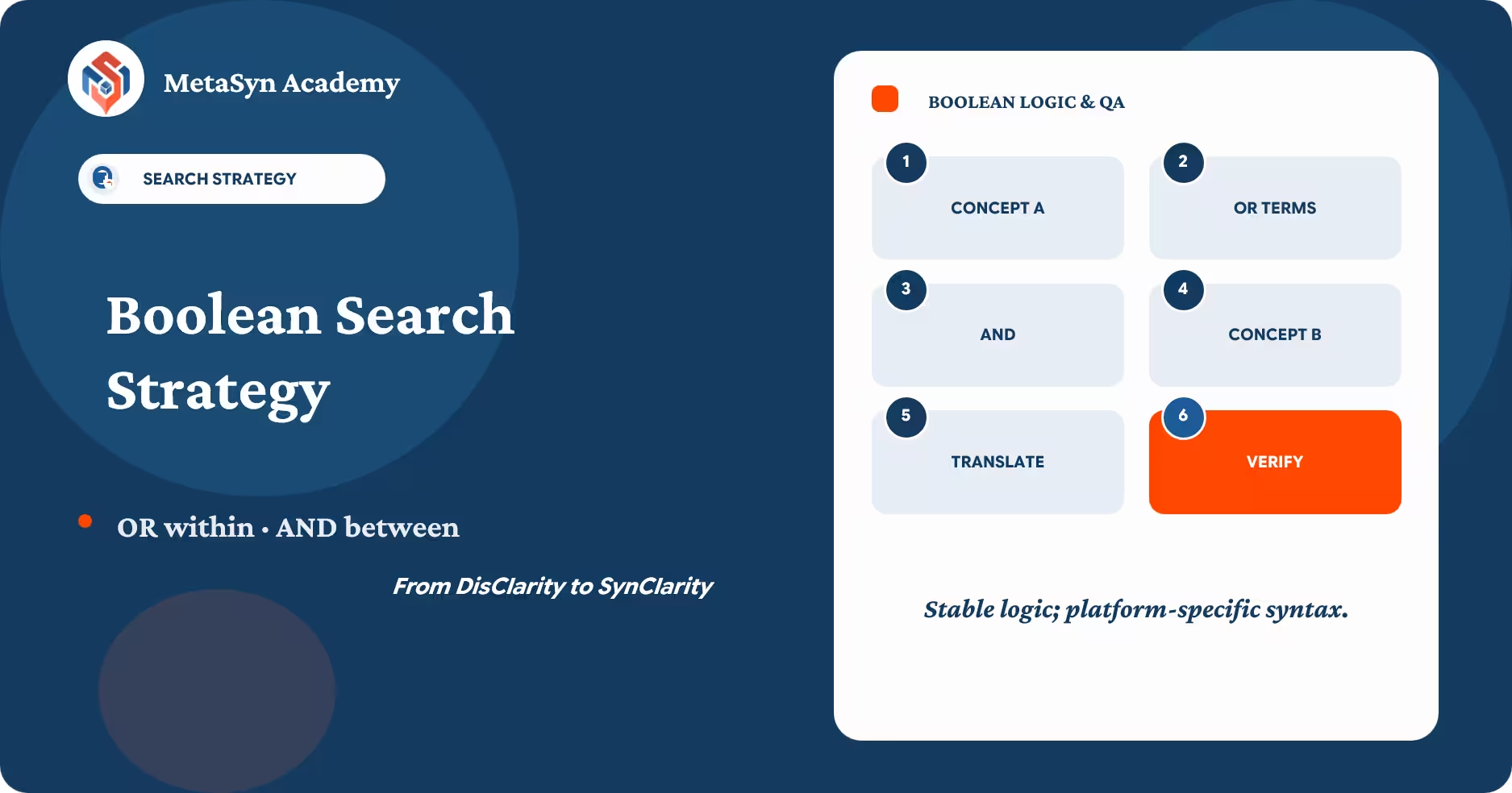
The practical rule: use OR to combine alternatives that represent the same concept, use AND to connect distinct concepts, group every concept block with parentheses, and translate the resulting logic for each database platform. Treat NOT, phrases, truncation, wildcards, proximity, fields, and subject headings as tools with testable consequences—not decorations added to make a query look sophisticated.
A systematic-review search needs to retrieve enough of the eligible evidence to support the review while remaining transparent and manageable. Boolean logic supplies the skeleton, but a defensible strategy also needs controlled vocabulary, free-text variants, platform-specific syntax, iterative testing, and an audit trail. Cochrane’s MECIR standards cover conduct; PRESS covers peer review; PRISMA-S covers reporting. None of them turns one sample query into a universal solution.123
This model also makes errors easier to locate. Noise inside one concept usually signals a term or field problem; an unexpectedly small intersection may indicate that a concept is unnecessary, too narrow, or poorly represented. Edit the block where the problem arises, rerun the test, and record what changed.
Start with concepts, not operators
Translate the review question into candidate searchable concepts, then decide which concepts genuinely need to constrain retrieval. A PICO question may contain population, intervention, comparator, and outcome, but searching all four elements can be unnecessarily restrictive. Comparator and outcome concepts are often poorly or inconsistently represented in titles, abstracts, and indexing. The right decision depends on the question, evidence type, terminology, and testing—not on a fixed number of blocks.
Record concepts that were considered but omitted. That note protects the team from later “improvements” that quietly reduce sensitivity and makes peer review easier.
OR broadens within a concept
OR joins alternative ways a relevant record may express the same idea. A block can include controlled-vocabulary headings, acronyms, spelling variants, earlier terminology, brand or generic names, abbreviations, and carefully chosen phrases:
(insomnia OR sleeplessness OR "sleep initiation and maintenance disorders")
The expression is illustrative. A real database strategy would label fields, add the platform’s subject heading where available, and test whether the phrase processing behaves as intended.
Every added synonym can improve coverage, but weak synonyms can add noise. Keep provenance: note whether a term came from a thesaurus, seed record, terminology analysis, expert consultation, previous review, or test result.
AND narrows between concepts
AND requires a record to satisfy each connected concept block. It is the bridge between distinct ideas:
(insomnia terms) AND (digital intervention terms)
Adding a third AND block usually reduces the result set because every retrieved record must now express all three concepts in searchable fields. That may improve precision, but it can also remove eligible records. Compare result counts, inspect relevant records, and investigate misses before accepting the change.
Parentheses make the intended order explicit
Search systems apply operators according to precedence rules, and those rules are not a safe basis for an auditable strategy. Group each concept block:
| Expression | Interpretation | Risk |
|---|---|---|
A OR B AND C | Depends on platform precedence. | May not represent the intended two-block strategy. |
(A OR B) AND C | A or B must be present, together with C. | Clear and portable as a logic model. |
(A OR B) AND (C OR D) | One term from each concept block. | Still requires platform-specific translation. |
Use NOT only after checking false exclusions
NOT can remove obviously unwanted meanings, but it can also discard relevant records that mention both the wanted and unwanted concept. If a NOT expression seems necessary, inspect excluded results, test known relevant records, document the reason, and keep the exact exclusion available for peer review. Improving a positive concept block is often safer than relying on a broad exclusion.
Phrases, truncation, and wildcards are platform behaviours
Phrase searching
Quotation marks do not mean exactly the same thing everywhere. A platform may search an exact phrase, apply automatic term mapping, ignore some punctuation, or break a phrase when truncation is present. Test the phrase and review the platform’s translation or search-details display where available.
Truncation and wildcards
Truncation retrieves multiple endings from a stem; a wildcard substitutes for one or more characters according to platform rules. A stem that is too short can retrieve unrelated words, while a stem that is too long can miss useful variants. Inspect the retrieved vocabulary rather than assuming the symbol behaves safely.
Proximity
Proximity asks for terms within a specified distance, sometimes in either order and sometimes in a required order. Distance counting, punctuation, stop words, field eligibility, and nesting vary by platform. Record the operator, distance, direction, fields, and documentation date.
"search terms"[field:~N]. For example, "digital intervention"[Title/Abstract:~3] asks for the two terms within three words in the Title/Abstract field. PubMed does not support wildcards inside a proximity expression: when a wildcard is present, the proximity operator is ignored.4
Field searching trades coverage for focus
Title and abstract fields are useful for free text because they usually describe a record’s content. Keyword fields can add author terms; subject-heading fields add indexed concepts. A title-only search may be precise but miss records whose title uses a broader term. An unrestricted text search may include affiliations, references, or metadata that generate noise. Choose fields for a reason and test the effect.
Controlled vocabulary and free text do different jobs
Controlled vocabulary gathers records indexed under a concept even when authors use different words. Free text helps retrieve recent, unindexed, incompletely indexed, or differently indexed records. A robust bibliographic-database strategy usually considers both. The heading syntax, explosion behaviour, subheadings, and vocabulary version belong to the database and platform; they cannot be copied blindly from another source.
Translate logic; do not transplant strings
The table below is an orientation map, not a substitute for current help. Product interfaces change, and the same database may be available on more than one platform.
| Platform | Common proximity form | Common field or vocabulary cue | Translation checkpoint |
|---|---|---|---|
| PubMed | "terms"[Title/Abstract:~N] | [Title/Abstract]; MeSH syntax | Wildcard inside proximity is incompatible; inspect Search Details. |
| Ovid | adjN | .ti,ab,kf.; database thesaurus lines | Confirm truncation symbol, adjacency direction, and database segment. |
| Embase.com | NEAR/n or NEXT/n | :ti,ab; Emtree | Distinguish unordered from ordered proximity and confirm explosion. |
| EBSCOhost | Nn or Wn | Database field codes; subject headings | Confirm unordered/ordered behaviour and database-specific field list. |
| ProQuest | NEAR/n or PRE/n | Field-code syntax varies by selected databases | Confirm which databases are searched together and how fields map. |
| Scopus | W/n or PRE/n | TITLE-ABS-KEY() | Check term limits, nesting, and exact operator direction. |
| Web of Science | NEAR/x | TS= and other field tags | Confirm field scope, lemmatization, and wildcard behaviour. |
| Cochrane Library | NEAR/n or NEXT/n | :ti,ab,kw; MeSH descriptor lines | Confirm Search Manager syntax and source coverage. |
Before final execution, open the current official help for the exact interface, preserve the help URL and access date, run syntax checks, and retain the exact query as executed. A translation tool can accelerate drafting, but a human must verify the output.
Test the strategy as a model
Testing is diagnostic. Use known relevant records to identify missing terminology or field problems; inspect samples of results to find noise; compare counts after each material change; examine subject headings and frequent terms; and record why a change was accepted or rejected. Relative recall can describe performance against a defined benchmark set, but it does not prove recall against all eligible studies.
Peer review and reporting
PRESS asks a reviewer to assess translation of the question, Boolean and proximity operators, subject headings, text words, spelling and syntax, and limits or filters.2 It is not the same as proofreading your own query. PRISMA-S asks authors to report sources, platforms, full strategies, limits, search dates, peer review, records, deduplication, and related details.3 Reporting the query accurately is essential, but reporting alone does not make the query methodologically sound.
Read the executed query, not only the query you typed
Platforms may map terms, expand subject headings, remove punctuation, ignore unsupported operators, or apply precedence in ways that are not obvious from the search box. After running a strategy, inspect the search details or history. Confirm that every line was interpreted as intended, every field exists on that platform, phrases behaved as expected, and limits were applied only once. Preserve the interpreted or executed form when the interface exposes it.
PubMed illustrates why this matters. Its proximity syntax places a quoted expression before a supported field and distance, as in "heart failure"[Title/Abstract:~3]. If a wildcard occurs inside that expression, PubMed states that the proximity operator is ignored.4 A query may still return results, so the failure is semantic rather than syntactic. The searcher must verify behavior rather than equate “ran successfully” with “worked as intended.”
Use NOT only after inspecting what it removes
NOT subtracts every record matching the excluded set, including records that also contain wanted concepts. It can be appropriate for a carefully tested exclusion, but it is rarely a safe shortcut for improving precision. Before retaining NOT, inspect excluded records, test known relevant studies, state the rationale, and preserve the exact excluded block. Consider whether a field restriction or a more specific positive concept would solve the problem with less risk.
Test one behavior at a time
A useful test plan links each revision to an observable question:
- Does a new synonym retrieve a known eligible record or mainly add noise?
- Does truncation retrieve intended word forms without crossing into an unrelated root?
- Does a phrase suppress relevant variants?
- Does proximity preserve flexible wording while excluding distant co-occurrence?
- Does a field restriction remove records in which the concept appears only in indexing?
- Does an added concept exclude known eligible studies?
Change one meaningful component where possible, compare results, examine missed and newly retrieved records, then write a short decision note. This produces a development history that a PRESS reviewer can understand. Recovering every record in a small benchmark is informative, but it cannot establish recall for eligible records that are absent from the benchmark.
Finish with a logic audit
Before peer review, read each block aloud as a set definition. Confirm that OR connects genuine alternatives, AND connects distinct necessary concepts, parentheses make precedence explicit, every behavior is platform-supported, and every restriction follows eligibility or an evidence-based filter decision. Then check the strategy against PRESS elements and prepare the exact final versions, dates, limits, and peer-review information needed for PRISMA-S reporting.23
References
- Lefebvre C, et al. Searching for and selecting studies. In: Cochrane Handbook for Systematic Reviews of Interventions, version 6.5. 2024. Official chapter.
- McGowan J, et al. PRESS Peer Review of Electronic Search Strategies: 2015 Guideline Statement. Journal of Clinical Epidemiology. 2016;75:40–46. https://doi.org/10.1016/j.jclinepi.2016.01.021.
- Rethlefsen ML, et al. PRISMA-S. Systematic Reviews. 2021;10:39. https://doi.org/10.1186/s13643-020-01542-z.
- U.S. National Library of Medicine. PubMed User Guide: Proximity searching. Accessed 23 July 2026. Official help.
- Bramer WM, et al. A systematic approach to searching. Journal of the Medical Library Association. 2018;106(4):531–541. https://doi.org/10.5195/jmla.2018.283.