
The Meta-Journey: An A-Z Systematic Review and Meta-Analysis Curriculum
This is not a course list. It is an integrated curriculum guiding researchers, analysts, and decision-makers from chaotic evidence to defensible, publication-ready synthesis, across academia, healthcare, HEOR, policy, education, and applied linguistics.
DisClarity
ConClarity
ProClarity
MasClarity
SynClarity
Each phase of the Meta-Journey moves you from one to the next.
This is not just a course outline. It is an integrated systematic review & meta-analysis curriculum..
You begin at the base camp of evidence chaos. You finish as a synthesis architect, someone who knows how to design, defend, and publish trustworthy conclusions. Every station is a checkpoint. Every checkpoint is a defensible decision. And you never walk alone.
Decision-Making
Protocol-First Logic
AI as Assistant
Sector-Agnostic
The Four Phases of the Meta-Journey
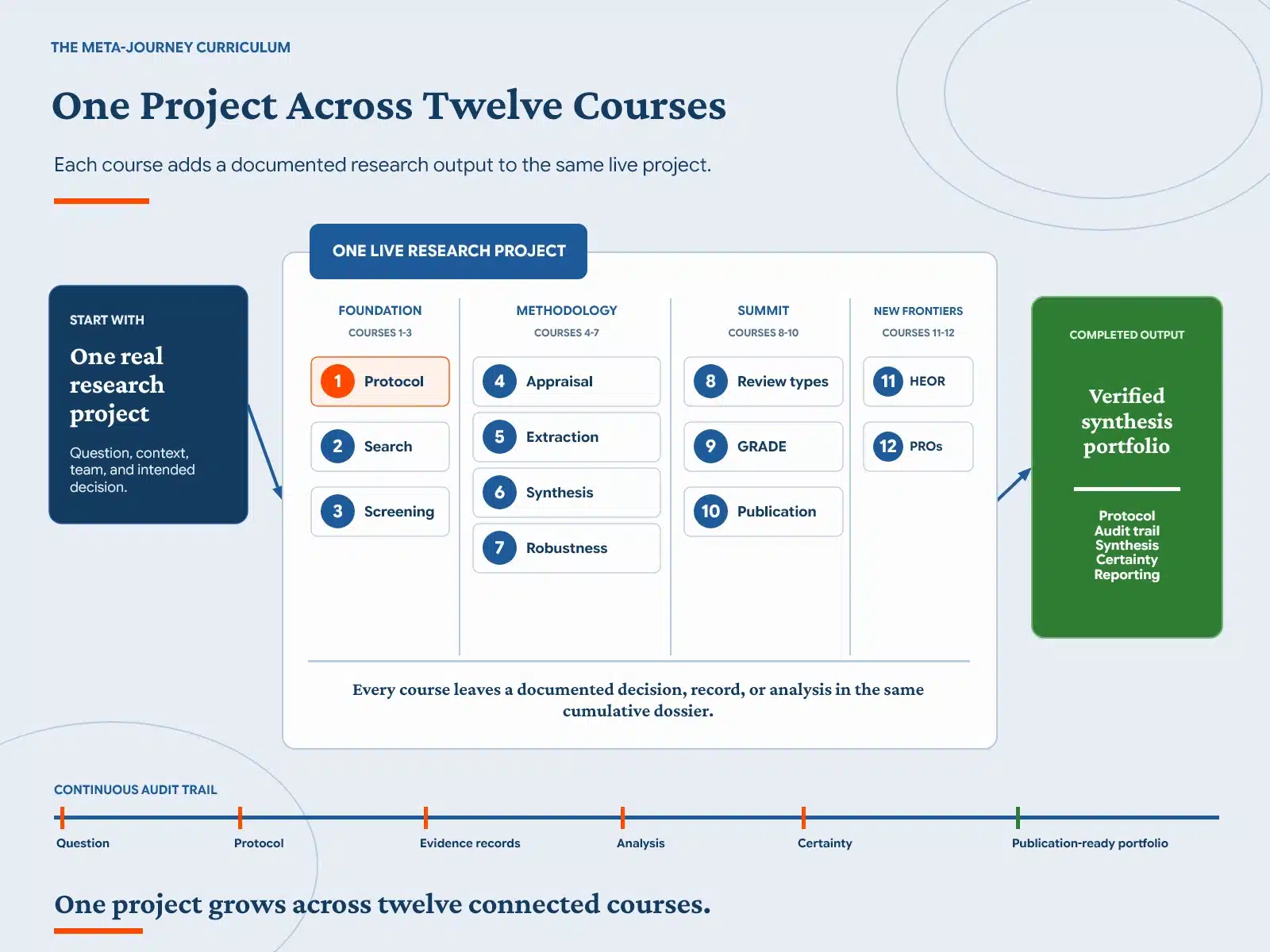
Thirteen courses, four phases, and five clarity states structure this systematic review & meta-analysis curriculum. Each phase moves you from one state of clarity to the next, DisClarity through to SynClarity.
Foundation: From DisClarity to ConClarity
Theme: Move from chaotic curiosity to a conceptually clear, registered protocol
Goal: Master protocol design, sensitive search strategy, and reproducible screening
Course 1
The Launchpad – Foundations & Protocol Design
From idea to PRISMA-P-aligned, registered protocol. Master research question frameworks, AI-assisted protocol drafting, and PROSPERO or The Open Science Framework registration on your own real research project.
Course 2
The Search – Reproducible Search Strategies for Systematic Reviews
Design search strategies that survive peer review. Master Boolean logic, MeSH and Emtree controlled vocabulary, grey-literature retrieval, and PRISMA-compliant search documentation across PubMed, Embase, Scopus, ERIC, and PsycINFO.
Course 3
The Sift – AI-Assisted Screening, Selection, and PRISMA Flow
Move from raw search yields to a defensible included-studies set. Title/abstract screening, full-text review, validated AI-screening tools, dual-reviewer workflows, inter-rater reliability documentation, and a publication-ready PRISMA flow diagram.
Methodology: From ConClarity to ProClarity
Theme: Turn methodological understanding into executed protocol skill
Goal: Master critical appraisal, structured data extraction, quantitative synthesis, and heterogeneity assessment
Course 4
Critical Appraisal & Risk of Bias Assessment
Critical appraisal using Cochrane RoB 2, ROBINS-I, ROBINS-E, JBI Critical Appraisal Tools, and domain-specific instruments. Defensible bias assessment for randomized,non-randomized, qualitative, and observational studies.
Course 5
Data Extraction & Management for Systematic Reviews
Design custom extraction forms, manage cross-reviewer data systematically, and ensure full reproducibility. Includes Covidence, DistillerSR, and EPPI-Reviewer workflows, plus open-source alternatives for small teams.
Course 6
Meta-Analysis Fundamentals – Effect Sizes, Pooling, and Forest Plots
Master meta-analysis fundamentals: effect size calculation, fixed and random-effects pooling, forest plots, prediction intervals, and statistical models. No-code workflows in R (metafor, meta) and dedicated meta-analysis software.
The Summit: From ProClarity to MasClarity
Theme: Produce defensible conclusions, certainty assessments, and publication-ready synthesis
Goal: Master diverse review types, GRADE certainty assessment, and publication grade reporting
Course 8
Diverse Review Types – Scoping, Rapid, Umbrella, and Living Reviews
Choose and execute the right review type for your question. Scoping reviews (JBI methodology), rapid reviews (Cochrane guidance), umbrella reviews and overviews of reviews, and living systematic reviews with continuous evidence updating.
New Frontiers: From MasClarity to SynClarity
Theme: Apply synthesis mastery to specialized sectors and apex methods
Goal: Master HEOR and market-access reviews, network meta-analysis, individual participant data synthesis, and second-order meta-analysis
Course 11
Systematic Reviews for HEOR & Market Access
Conduct systematic reviews and indirect treatment comparisons (including network meta-analysis) for HTA submissions and reimbursement decisions,methodologically aligned with published guidance from NICE, IQWiG, CADTH, ICER, PBAC, and the EU HTA Regulation (EU) 2021/2282 (applicable from 12 Jan 2025)
Course 12
Apex Methods – Network Meta-Analysis, IPD Synthesis, and Second-Order Meta-Analysis
The apex methods of evidence synthesis. Network meta-analysis for indirect comparisons, individual participant data (IPD) meta-analysis, second-order meta-analysis (umbrella synthesis of meta-analyses), and patient-reported outcomes synthesis for value demonstration.
Course 13
Professional Practice in Evidence Synthesis
Move from learning evidence-synthesis methods to applying them responsibly in professional practice. Develop role awareness, demonstrable competence, teaching and supervision, consulting, evidence leadership, decision support, and accountable AI-enabled practice.
Free reference library
Companion Methodology and Professional Guides
Each course is supported by a free, independently useful guide. Use these references to examine the methodology, reporting standards, and professional context behind the taught curriculum.
Pre-Register for the Founder’s List
Pre-registered learners join the Founder’s List for the courses they select across the Meta-Journey. Founder’s List members receive: (1) syllabus previews 4–6 weeks before public launch, (2) locked-in early-bird pricing guaranteed even if standard pricing rises, (3) priority enrollment in the seven-day window before public open, and (4) invitation to Dr. Robat’s founding cohort Q&A before the course begins. No payment required to pre-register.
Why This Systematic Review & Meta-Analysis Curriculum Releases One Course at a Time
This twelve-course curriculum releases progressively. Course 1 opens with the academy launch. Subsequent courses open on a rolling cadence over the following months, with each course’s modules releasing weekly across a 6–7-week structured release window. This is deliberate, not logistical. Real systematic review work happens in stages: protocol, search, screen, extract, synthesize, report, and each stage must be done well before the next is meaningful. A student who has not yet completed a defensible protocol cannot meaningfully practice critical appraisal. A student who has not built a reproducible search cannot evaluate screening decisions. The cohort cadence mirrors the natural pace of real evidence work.
What Travels With You Across All 13 Stations
Four supports follow you across the Meta-Journey, from Course 1 to the Summit Circle. They aren’t course content, they’re the infrastructure that makes the journey possible.
AI Companions (Validated)
Validated AI tools that assist you at every checkpoint, protocol drafting, search
translation, screening, extraction, synthesis. AI assists, you decide. Every action is
documented for transparency.
Working Templates & Workspaces
Pre-built PRISMA-aligned workbooks, extraction forms, and reproducible workspace architectures. You don’t download blanks, you fill working documents alongside the lessons, on your own real research project.
Expert Guidance
Personal feedback from Dr. Saeedy Robat for founding-cohort members within 3 business days. Office hours, methodological consultation, and direct access at every checkpoint.
Peer Community (Campfire)
Connect with fellow evidence synthesizers, share challenges, and collaborate across sectors and disciplines. Share the synergistic logic and the joy of the journey.
Frequently Asked Questions
The questions we hear most about the Meta-Journey, answered clearly and without marketing language.
Begin Your Meta-Journey
The Meta-Journey is a transformation, not a destination. Your Meta-Journey is ready. From DisClarity to SynClarity. From chaotic curiosity to defensible synthesis. From learner to evidence leader. The first step is Course 1.