
How the GRADE Evidence-to-Decision Framework Works in Evidence Synthesis
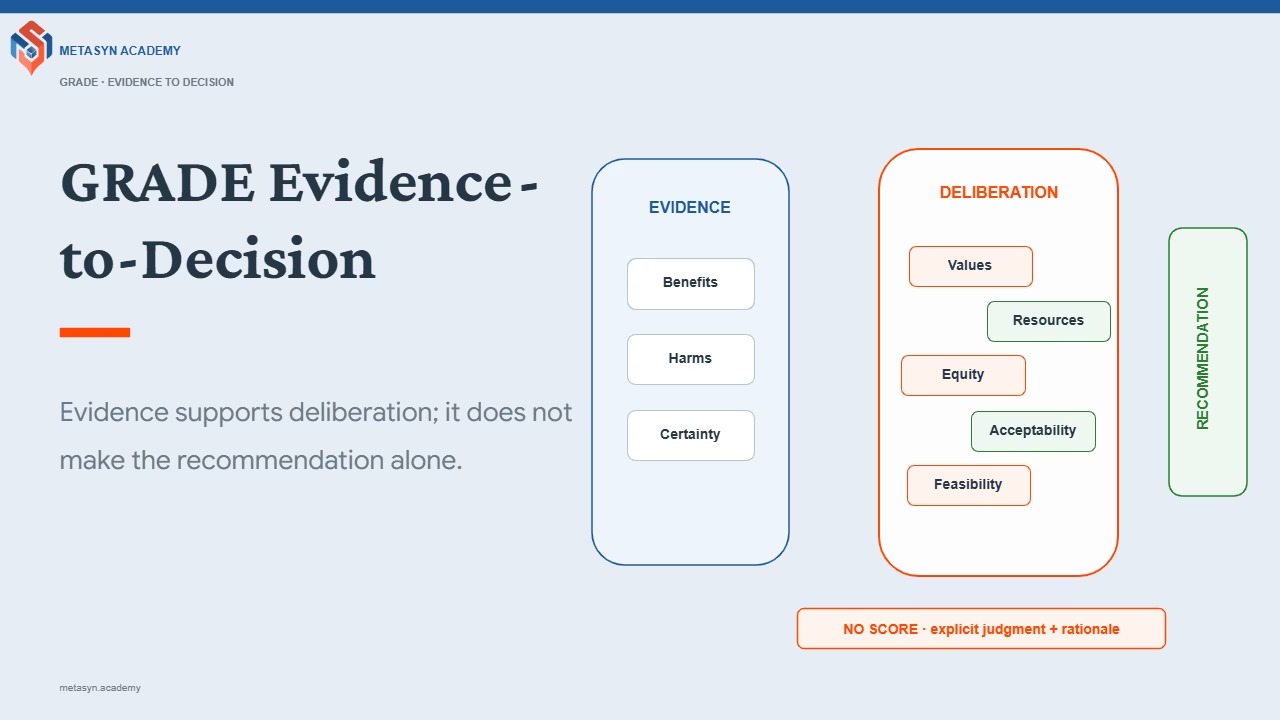
A meta-analysis can estimate an effect, and GRADE can tell us how certain we are about that effect. Neither step answers the final decision question. Recommendation development starts when those findings have to be interpreted alongside values, burden, resources, equity, acceptability, feasibility, and the authority of a decision-making panel.
The GRADE Evidence-to-Decision (EtD) framework was created to make that reasoning explicit. Its purpose is to structure the judgments that connect evidence to a recommendation, record the evidence supporting those judgments, and make the final conclusion inspectable by people who were not in the room.1,2 The framework does not assign points to criteria and does not calculate a recommendation.
A recommendation begins where evidence synthesis stops
This boundary matters because systematic-review authors and guideline panels perform different jobs. Review authors estimate effects, characterize uncertainty, and explain what the evidence supports. A guideline panel must then decide whether those effects are important enough to favor one option, whether people value the outcomes similarly, whether costs and implementation burdens are acceptable, and whether a recommendation would widen or reduce inequity. The original GRADE EtD papers therefore describe healthcare decision making as a process in which the relevant criteria depend partly on the type of decision being made.2,3
For an evidence-synthesis team, the safest use of EtD is to prepare the evidence side of the record and make clear where panel judgment begins. A systematic review does not acquire the mandate to issue a clinical, reimbursement, or public-health recommendation simply because its authors have completed an EtD form. Governance, stakeholder representation, conflict-of-interest management, and the identity of the body responsible for the decision remain part of the method.
Core GRADE 7 changes how the criteria are organized
Core GRADE 7, published in 2025, is the current authoritative account of moving from evidence to recommendations. It distinguishes primary considerations from secondary considerations rather than presenting every EtD criterion as an undifferentiated list.1 The primary considerations concern the consequences that matter directly to patients: desirable and undesirable effects, certainty in those effects, and values and preferences. The balance of effects is the panel’s integrated judgment about those consequences. Secondary considerations include costs, feasibility, acceptability, and equity, and become especially important when recommendations are considered from population, health-system, or policy perspectives.
How large and important are the benefits, harms, and burdens? Absolute effects and patient-important outcomes matter more than statistical significance alone.
How confident is the panel in the outcome claims that matter to the decision? Certainty informs recommendation strength but does not dictate it.
How do patients or the relevant population value the outcomes, and how much meaningful variability or uncertainty exists?
After considering magnitude, certainty, and values, does the overall consequence profile favor one option, neither option, or vary across groups?
What resources are required from the stated perspective, how certain are those estimates, and what does formal cost-effectiveness evidence show?
Will benefits, harms, access, or resource requirements be distributed differently across groups in a way that changes inequity?
Do relevant stakeholders regard the option as acceptable? Patient, clinician, payer, and community views may differ.
Can the option realistically be implemented given workforce, infrastructure, regulation, logistics, and delivery capacity?
The distinction is organizational, not mathematical. Primary considerations are not assigned higher numerical weights, and secondary considerations are not optional simply because they are called secondary. A resource or feasibility problem can alter the strength, scope, or conditions of a recommendation even when the clinical-effect evidence is favorable.
Benefits and harms are interpreted through importance, not significance
EtD reasoning starts with the magnitude of desirable and undesirable effects. The key question is not whether a p value crosses a conventional threshold. It is whether the consequences are important to the people affected, how large the absolute changes are, and how certain those conclusions are. Core GRADE 7 links this reasoning to explicit thresholds for important effects and to patient values.1
This creates an important separation from a conventional results section. A review can report a statistically precise relative effect without establishing that the absolute benefit is meaningful at the baseline risks relevant to the decision. Conversely, a clinically important effect may remain uncertain. EtD deliberation needs both magnitude and certainty because they answer different questions.
Values are evidence about outcome importance, not panel preference
Values and preferences describe the importance patients or populations place on outcomes and the extent to which that importance varies. Direct evidence may come from qualitative research, preference studies, surveys, or systematic reviews of values. When direct evidence is absent, assumptions should be stated as assumptions rather than presented as though they were observed facts.
This criterion is easy to misuse because the word values can sound like an invitation to free-form opinion. It is not. A panel member’s preference for a treatment is not evidence of patient values. The useful questions are more concrete: How strongly do people value the expected benefit? How much burden will they tolerate? Do subgroups value the trade-off differently? How certain is the evidence about those preferences?
Balance of effects is a judgment, not a subtraction
The balance-of-effects judgment brings together benefits, harms, certainty, and values. It cannot be reproduced by subtracting a harm score from a benefit score because the outcomes do not share a common unit and because importance depends on the people affected. A small serious harm may matter more than several modest benefits. A treatment burden that looks minor to clinicians may matter greatly to patients. The reasoning has to be written down.
A useful balance statement identifies the tension. For example: “Benefits probably outweigh harms for most patients, but the balance is less favorable where treatment burden is highly valued or baseline risk is low.” That sentence tells the reader what changes the decision. A label such as “favorable balance” does not.
Resources and cost-effectiveness answer different questions
Resource requirements concern what must be spent, supplied, or displaced to implement an option. The relevant perspective must be explicit because a cost to a health system can be a saving to a patient, and the reverse can also occur. Workforce time, equipment, training, infrastructure, and opportunity cost can matter as much as purchase price.
Cost-effectiveness is a separate economic question. It asks whether incremental consequences justify incremental resource use relative to an alternative, usually under an explicit willingness-to-pay or decision threshold. Saying that an intervention “costs more” is therefore not a cost-effectiveness analysis. Coverage and reimbursement decisions often need formal economic evidence, while a clinical recommendation may have less detailed resource inputs depending on scope and jurisdiction.3
Equity asks who gains, who loses, and who can reach the intervention
An equity judgment is distributional. It asks whether the option changes differences in access, outcomes, burden, or resource allocation across groups, especially groups already experiencing disadvantage. A treatment with favorable average effects can still worsen equity if its delivery model excludes people who cannot reach specialist services, afford time away from work, obtain digital access, or meet other practical conditions.
WHO-INTEGRATE makes equity, equality, and non-discrimination especially explicit in population and system decisions, alongside human-rights and sociocultural considerations.5 That framework is not interchangeable with core GRADE EtD, but it shows why population-level decisions often require a broader evidentiary frame than a clinical recommendation for an individual patient.
Acceptability and feasibility should never share one box
Acceptability concerns stakeholder response. Feasibility concerns capacity to implement. A program can be highly acceptable to patients but impossible to deliver because trained staff are unavailable. It can also be technically feasible yet unacceptable to clinicians, communities, or payers. Combining these criteria hides exactly the kind of conflict an EtD framework is meant to expose.
Certainty and recommendation strength are related but not equivalent
Core GRADE 7 states that strong recommendations are generally made when certainty is high or moderate, while low-certainty evidence usually leads to conditional recommendations. The word generally matters. GRADE recognizes exceptional situations in which a strong recommendation can be defensible despite low or very low certainty, for example when the consequences of inaction are severe or when one option has clear advantages in harm, burden, or cost under conditions of uncertainty.1,9
A strong recommendation therefore cannot be generated from a certainty label. Nor does low certainty mean “do nothing.” The panel has to consider what is known, what remains uncertain, what people value, and what the consequences of action or inaction are. In some situations the appropriate conclusion may be conditional. In others it may be a recommendation only in the context of research.
| Conclusion | What it usually means | What the justification should make clear |
|---|---|---|
| Strong for | The panel judges that desirable consequences clearly outweigh undesirable consequences for almost all relevant people or settings. | Why the balance is sufficiently clear, and any exceptional reasoning if certainty is low. |
| Conditional for | The option is favored, but the best choice may vary with values, baseline risk, resources, setting, or another relevant consideration. | Which conditions or preferences can reasonably change the choice. |
| No recommendation | The panel cannot justify direction at present. | Whether uncertainty concerns effects, values, context, or disagreement. |
| Only in research | Use is linked to generation of evidence because uncertainty is material and further research is feasible and worthwhile. | What uncertainty the research must resolve and why routine use is premature. |
| Conditional / strong against | The balance favors the comparator or avoidance of the option, with conditionality depending on how stable that judgment is across people and settings. | The consequences that drive the recommendation against. |
The panel is part of the method
EtD frameworks improve transparency only if readers can see who made the judgments and under what governance. Relevant stakeholders should be represented. Conflicts of interest should be declared and managed. Consensus or voting procedures should be described. Material disagreement should not disappear simply because the final recommendation has been approved.
Recorded panel deliberations provide an empirical view of this process. Li and colleagues analyzed five guideline panels and found that formal GRADE criteria accounted for 94% of discussion content. Effects dominated the discussion, while values/preferences and equity occupied much smaller shares.4 That finding is descriptive rather than prescriptive. It shows how structured criteria shape deliberation and also raises a practical question: criteria that are difficult to measure can receive less attention even when they are methodologically required.
EtD variants share a logic, not an identical form
The original GRADE EtD work covered clinical recommendations, coverage decisions, and health-system or public-health decisions.2 GRADE has also developed specific EtD approaches for tests and test strategies.11 WHO-INTEGRATE offers a related framework designed especially for complex population and system interventions.5
| Decision type | Common emphasis | Methodological caution |
|---|---|---|
| Clinical recommendation | Patient-important effects, certainty, values, burden, and treatment choice. | Do not assume population-level resource or equity considerations are irrelevant; their importance depends on scope. |
| Public health | Population effects, distribution, equity, societal implications, implementation across systems. | Clinical EtD fields alone may be too narrow for complex population interventions. |
| Coverage / reimbursement | Economic evaluation, budget consequences, opportunity cost, access. | Price difference is not a substitute for cost-effectiveness. |
| Health system | Workforce, infrastructure, service capacity, feasibility, organizational consequences. | Evidence may be highly context-dependent and poorly transferable. |
| Tests / test strategies | Consequences of true and false results, downstream management, direct and indirect patient-important effects. | Diagnostic accuracy alone is not the decision outcome. |
A worked example: favorable efficacy, constrained delivery
The following scenario is hypothetical. Its purpose is to show how EtD criteria can legitimately point in different directions.
Hypothetical knee-osteoarthritis recommendation
Suppose a panel considers a structured 12-week home-based exercise program for adults with moderate chronic knee osteoarthritis, compared with usual care and as-needed analgesia. The invented evidence suggests a meaningful reduction in pain with moderate certainty and only minor exercise-related discomfort. On those facts alone, the intervention looks attractive.
The hypothetical panel therefore issues a conditional recommendation for the program, with an implementation condition addressing access and supervision. Favorable efficacy did not disappear. It simply did not settle the whole decision.
Common EtD errors have a recognizable pattern
| Error | Why it fails | Better practice |
|---|---|---|
| Adding points across criteria | GRADE EtD is deliberative; criteria are not commensurable numerical units. | Record each judgment, evidence, uncertainty, and rationale separately. |
| High certainty = strong recommendation | Certainty does not include values, balance, resources, equity, acceptability, or feasibility. | Use certainty as one input and justify strength explicitly. |
| Reviewer opinion entered as patient values | It substitutes panel preference for evidence about outcome importance. | Seek values evidence and label assumptions when direct evidence is absent. |
| Acceptability merged with feasibility | A stakeholder can accept an option that the system cannot deliver, or reject one that is technically feasible. | Assess the criteria separately. |
| Costs labeled as cost-effectiveness | Cost-effectiveness requires comparison of incremental resources and consequences. | Keep resource requirements, certainty in resource evidence, and economic evaluation distinct. |
| EtD completed after a decision is already fixed | The framework becomes retrospective justification rather than prospective deliberation. | Use the criteria before finalizing direction and strength. |
| Systematic-review authors issue policy conclusions alone | Evidence synthesis does not supply governance or stakeholder authority. | Separate evidence preparation from panel recommendation-making. |
What empirical research says about EtD use
Methodological guidance tells us how EtD should work. Empirical studies tell us how it is being used. Meneses-Echavez and colleagues reviewed 68 guidance documents and found that use of an EtD framework was associated with inclusion of a more comprehensive set of recommendation criteria, particularly values, equity, and acceptability.6 In a later study of 66 guidelines from 17 countries, guidelines using EtD frameworks scored higher across all assessed AGREE-II and AGREE-REX domains than guidelines without a framework.7
These results support the practical case for structured deliberation, but they should not be overinterpreted. The studies are not randomized tests showing that EtD use causes better decisions. Organizations that use explicit frameworks may also differ in methods expertise, resources, governance, or editorial standards. The evidence is best read as an implementation signal: structured decision records are associated with more complete and transparent recommendation development.
What changed in 2025 and 2026
The main substantive update is Core GRADE 7. Its primary-versus-secondary organization gives a clearer account of how patient-level consequences relate to population and system considerations, and it reiterates that recommendation direction and strength depend on explicit judgments rather than a formula.1 A 2026 review by Meneses-Echavez and colleagues places EtD frameworks in a wider history of guideline methodology and identifies expansion toward issues such as planetary health and human rights, while treating AI-assisted EtD navigation as an emerging area that still needs methodological safeguards.8
No 2026 source identified in the research dossier formally supersedes Core GRADE 7. That matters for implementation. AI can help organize evidence, check whether a record is complete, or surface missing documentation. It should not quietly decide the balance of effects, infer stakeholder values, or turn criteria into a recommendation score.
How EtD connects to the preceding GRADE work
The methodological sequence is easier to understand when each product keeps its own job. A GRADE Summary of Findings Table Template for Systematic Reviews communicates the effects and certainty for critical outcomes. A GRADE Certainty-of-Evidence Assessment Worksheet for Systematic Reviews preserves the domain-level reasoning behind those certainty judgments. The GRADE Evidence-to-Decision Framework Template for Evidence Synthesis then uses those outputs as inputs to a different process: recommendation deliberation.
Conclusion
The central contribution of an Evidence-to-Decision framework is traceability. It shows how a panel interpreted effects and certainty, what evidence informed values and contextual criteria, where the decision was sensitive to setting or stakeholder preferences, and why the final recommendation had its particular direction and strength. That record matters precisely because recommendations contain judgments that cannot be recovered from a forest plot or certainty label alone.
GRADE Evidence-to-Decision framework
Frequently asked questions
What is the main purpose of a GRADE Evidence-to-Decision framework?
Its purpose is to make the evidence and judgments behind a recommendation explicit and transparent. It organizes the decision question, the relevant criteria, the evidence supporting each judgment, and the panel’s final conclusion.2
Is an Evidence-to-Decision framework part of the systematic review itself?
No. It is downstream from evidence synthesis. A systematic review supplies effect estimates and certainty information, while an EtD process adds values, contextual criteria, panel deliberation, and recommendation judgments.
Can a recommendation be strong when certainty of evidence is low?
What is the difference between values and acceptability?
Values concern the importance people place on outcomes and burdens. Acceptability concerns whether stakeholders regard the intervention, policy, or implementation arrangement as acceptable. The evidence sources and questions are different.
What is the difference between acceptability and feasibility?
Acceptability is about stakeholder response. Feasibility is about whether the option can actually be implemented with the available infrastructure, workforce, regulation, logistics, and delivery capacity.
Do all EtD frameworks have the same criteria?
Source record
References
Primary GRADE sources define the methodology. Empirical studies are used only to describe implementation and observed guideline quality.
- Guyatt G, Vandvik PO, Iorio A, et al. Core GRADE 7: principles for moving from evidence to recommendations and decisions. BMJ. 2025;389:e083867. doi:10.1136/bmj-2024-083867. PMID: 40461180.
- Alonso-Coello P, Schünemann HJ, Moberg J, et al. GRADE Evidence to Decision (EtD) frameworks: a systematic and transparent approach to making well informed healthcare choices. 1: Introduction. BMJ. 2016;353:i2016. doi:10.1136/bmj.i2016. PMID: 27353417.
- Alonso-Coello P, Oxman AD, Moberg J, et al. GRADE Evidence to Decision (EtD) frameworks: a systematic and transparent approach to making well informed healthcare choices. 2: Clinical practice guidelines. BMJ. 2016;353:i2089. doi:10.1136/bmj.i2089. PMID: 27365494.
- Li SA, Alexander PE, Reljic T, et al. Evidence to Decision framework provides a structured “roadmap” for making GRADE guidelines recommendations. J Clin Epidemiol. 2018;104:103–112. doi:10.1016/j.jclinepi.2018.09.007. PMID: 30253221.
- Rehfuess EA, Stratil JM, Scheel IB, et al. The WHO-INTEGRATE evidence to decision framework version 1.0: integrating WHO norms and values and a complexity perspective. BMJ Glob Health. 2019;4(Suppl 1):e000844. doi:10.1136/bmjgh-2018-000844.
- Meneses-Echavez JF, Bidonde J, et al. Evidence to decision frameworks enabled structured and explicit development of healthcare recommendations. J Clin Epidemiol. 2022;150:51–62. doi:10.1016/j.jclinepi.2022.06.004. PMID: 35710054.
- Meneses-Echavez JF, Bidonde J, Montesinos-Guevara C, et al. Using evidence to decision frameworks led to guidelines of better quality and more credible and transparent recommendations. J Clin Epidemiol. 2023;162:38–46. doi:10.1016/j.jclinepi.2023.07.013. PMID: 37517506.
- Meneses-Echavez JF, Alonso-Coello P, Vist GE, et al. Evidence-to-Decision Frameworks: Enhancing the Quality and Rigour of Guidelines and Recommendations. Clinical and Public Health Guidelines. 2026;3(3):e70078. doi:10.1002/gin2.70078.
- Canadian Task Force on Preventive Health Care. Development of Recommendations. Chapter 5. Methods Manual. 2023. Available from: Canadian Task Force.
- Guyatt G, et al. Core GRADE 6: presenting the evidence in summary of findings tables. BMJ. 2025;389:e083866. doi:10.1136/bmj-2024-083866.
- Schünemann HJ, Mustafa RA, Brozek J, et al. GRADE Guidelines: 16. GRADE evidence to decision frameworks for tests in clinical practice and public health. J Clin Epidemiol. 2016;76:89–98. doi:10.1016/j.jclinepi.2016.01.032.

